




 Chat with us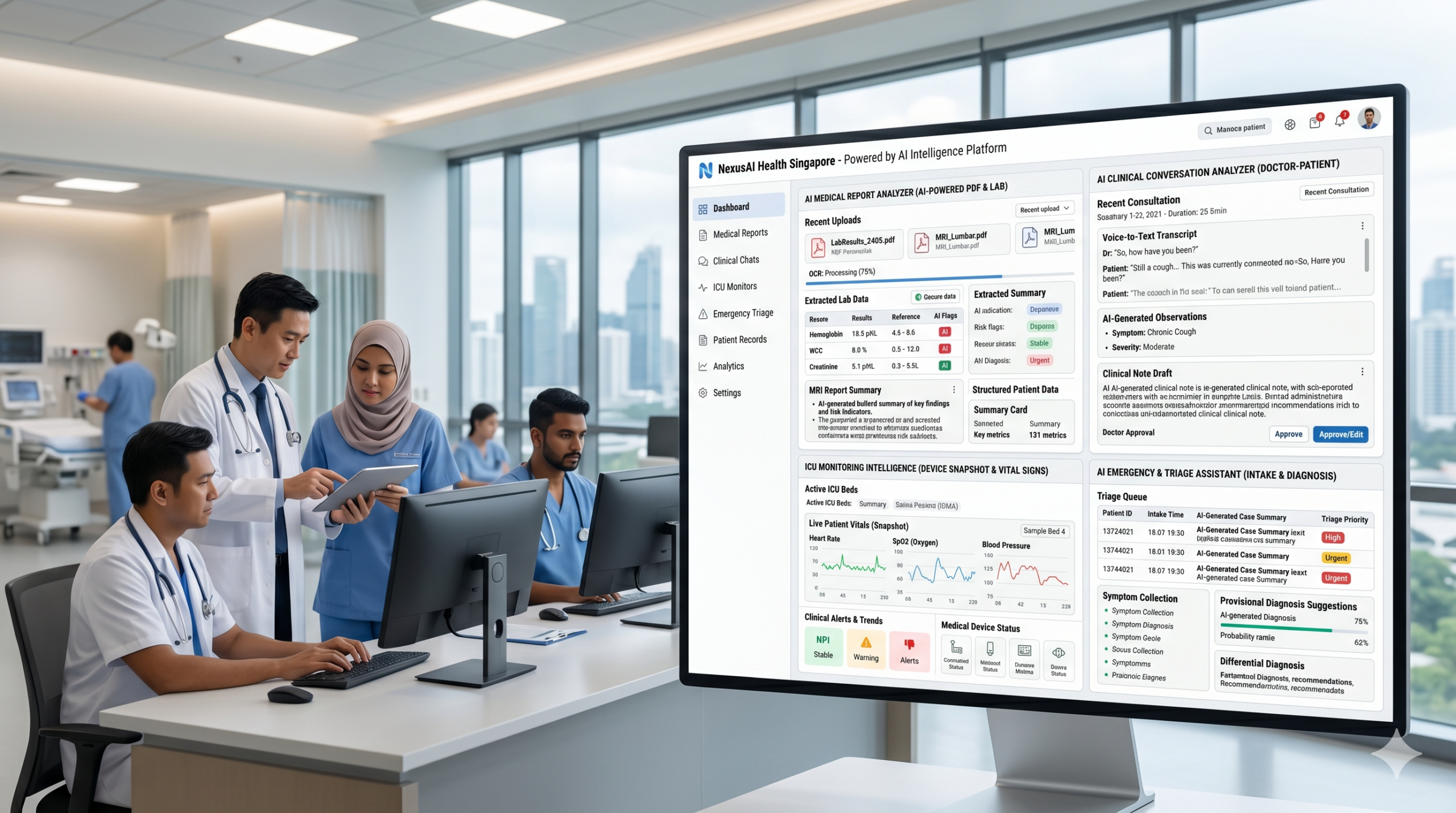

How Moirai Tech Singapore Leveraged Artificial Intelligence to Transform Medical Documentation, Clinical Data Extraction, and Emergency Triage Workflows
Introduction
Healthcare professionals spend a significant portion of their time documenting patient interactions, reviewing medical reports, consolidating information from multiple systems, and performing repetitive administrative tasks. As healthcare organizations strive to improve patient outcomes while managing increasing workloads, the need for intelligent automation has become more critical than ever.
Moirai Tech Singapore envisioned a next-generation healthcare intelligence platform capable of reducing manual effort, improving clinical efficiency, and enabling healthcare professionals to focus more on patient care. To bring this vision to life, Moirai Tech partnered with Quocent to develop a suite of AI-powered solutions that automate medical data extraction, clinical documentation, patient assessment, and healthcare decision support.
The result was an integrated healthcare intelligence platform that leverages modern AI technologies to streamline clinical operations while maintaining accuracy, accessibility, and scalability.
About the Client
Moirai Tech is a Singapore-based healthcare technology company focused on building innovative digital solutions that improve healthcare delivery and patient experiences.
As healthcare organizations increasingly adopt digital technologies, Moirai sought to create a platform capable of transforming unstructured medical information into actionable clinical insights while reducing the documentation burden on healthcare professionals.
Their vision was to combine artificial intelligence, medical data processing, conversational interfaces, and clinical decision support into a unified healthcare ecosystem.
The Challenge
Healthcare data exists in multiple formats and locations, making it difficult for clinicians to access and utilize information efficiently.
Moirai identified several key challenges across healthcare operations.
Manual Processing of Medical Documents
Healthcare institutions routinely receive medical reports, laboratory results, discharge summaries, prescriptions, imaging reports, and handwritten notes in various formats.
Extracting clinically relevant information from these documents often requires significant manual effort and increases the risk of delays and human error.
Monitoring Data Locked Within Medical Devices
Critical patient information displayed on ICU monitoring screens and medical devices is not always readily available in structured digital formats for analysis, reporting, or integration with healthcare applications.
Administrative Burden of Clinical Documentation
Doctors and healthcare professionals spend substantial time documenting patient interactions, creating clinical notes, and preparing consultation summaries.
This administrative workload reduces time available for direct patient care.
Emergency Department Triage Bottlenecks
Accident and Emergency (A&E) departments often experience high patient volumes, creating challenges in collecting patient information quickly and consistently before clinical assessment.
Healthcare providers required a solution capable of assisting with patient intake while supporting triage prioritization.
The Solution
Quocent developed a comprehensive AI-powered healthcare intelligence platform consisting of four interconnected solution components.
The platform was designed using a modern API-first architecture that integrates proven AI technologies and healthcare workflows without requiring the development of proprietary AI models.
Solution 1: AI-Powered Medical Document Intelligence
The first component focused on automating the extraction and interpretation of information from patient-related documents.
Capabilities
- Extraction of structured data from PDFs, scanned documents, images, laboratory reports, and medical records.
- OCR-based processing of both digital and scanned medical content.
- Automated identification of clinically relevant information.
- Transformation of unstructured medical documents into structured healthcare datasets.
- Intelligent categorization and indexing of patient records.
Business Value
Healthcare professionals no longer need to manually review large volumes of reports to identify key information.
The platform accelerates access to clinical insights while improving consistency and reducing administrative effort.
Solution 2: Camera-Based ICU Data Extraction
To address the challenge of capturing information displayed on medical equipment, Quocent developed an intelligent image-processing engine capable of converting visual monitoring data into structured information.
Capabilities
- Processing of snapshots captured from ICU monitoring devices.
- Extraction of vital signs and medical observations displayed on screens.
- Conversion of visual data into machine-readable healthcare records.
- Automated reporting and monitoring support.
- Integration-ready structured datasets for downstream analytics.
Business Value
Healthcare providers gain access to valuable monitoring information that would otherwise remain isolated within device displays.
The solution improves visibility, reporting accuracy, and operational efficiency.
Solution 3: AI-Powered Clinical Note-Taking & Medical Transcription
One of the most impactful components of the platform was the implementation of AI-assisted clinical documentation.
The solution enables automated transcription and intelligent summarization of doctor-patient conversations conducted either face-to-face or through telemedicine consultations.
Capabilities
- Real-time voice-to-text transcription.
- Automated generation of clinical notes.
- Intelligent summarization of consultations.
- Extraction of symptoms, observations, diagnoses, and treatment discussions.
- Doctor review and approval workflow.
- Direct integration into clinical dashboards.
Technology Approach
The platform utilizes advanced speech recognition and generative AI technologies, including large language models and transcription services, to ensure high levels of accuracy and usability.
Business Value
Doctors spend less time documenting consultations and more time focusing on patient care.
The solution improves productivity while maintaining high-quality clinical records.
Solution 4: AI-Powered Emergency & Triage Assistant
To enhance patient intake and triage processes, Quocent developed a web-based AI assistant designed specifically for Accident & Emergency environments.
Capabilities
- Conversational patient interviews.
- Collection of symptoms and medical history.
- Structured patient onboarding.
- AI-generated case summaries.
- Provisional diagnosis suggestions.
- Differential diagnosis recommendations.
- Triage support for healthcare professionals.
Ecosystem Integration
The solution supports integration with broader healthcare ecosystems, including:
- Smartwatch health monitoring devices
- Mobile healthcare applications
- Patient self-service kiosks
- Clinical dashboards
This creates a seamless patient journey from onboarding through clinical evaluation.
Business Value
Healthcare organizations can improve triage efficiency, standardize patient intake processes, and reduce waiting times while supporting clinical decision-making.
Key Outcomes
The AI-powered healthcare platform delivered measurable operational benefits across multiple areas.
Reduced Administrative Burden: Automation significantly decreases manual effort associated with medical documentation and data entry.
Faster Access to Clinical Information: Healthcare professionals gain quicker access to structured patient information and medical insights.
Improved Clinical Productivity: Doctors and clinical staff spend more time on patient care and less time on repetitive administrative activities.
Enhanced Decision Support: AI-generated summaries and structured data help clinicians make informed decisions more efficiently.
Better Patient Experience: Streamlined onboarding, faster documentation, and improved information accessibility contribute to a more seamless patient journey.
Scalable Digital Healthcare Foundation: The platform establishes a scalable framework that can evolve alongside future AI innovations and healthcare requirements.
Technology Highlights
The solution leverages a combination of modern AI and cloud technologies, including:
- Optical Character Recognition (OCR)
- Generative AI Models
- Speech-to-Text Processing
- Medical Data Extraction Frameworks
- Intelligent Document Processing
- Conversational AI
- Clinical Decision Support Technologies
- API-Driven Healthcare Integrations
By strategically adopting proven AI platforms rather than building custom models from scratch, the solution achieved faster deployment, reduced implementation risk, and accelerated value realization.
Conclusion
Moirai Tech’s vision of creating an AI-driven healthcare intelligence ecosystem became a reality through the successful implementation of intelligent automation capabilities across documentation, medical data extraction, patient onboarding, and clinical decision support.
The platform demonstrates how healthcare organizations can leverage artificial intelligence not merely as a technology enhancement, but as a strategic enabler of better patient care, operational efficiency, and clinical excellence.
As healthcare continues its digital transformation journey, AI-powered solutions such as these will play an increasingly important role in empowering clinicians, improving patient experiences, and enabling smarter healthcare delivery.